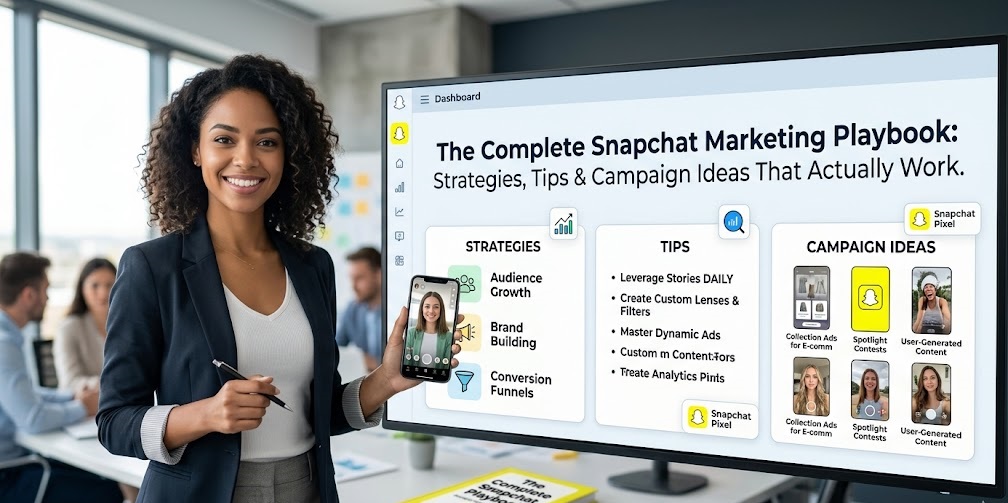
The Complete Snapchat Marketing Playbook:
Strategies, Tips & Campaign Ideas That Actually Work
A complete, no-fluff guide to growing your brand on Snapchat — from Snap Ads and AR lenses to Spotlight campaigns and influencer partnerships. Real tactics, real results.
Topics covered in this guide
- Why Snapchat still matters for marketers
- Understanding the Snapchat audience
- Snapchat ad formats explained
- Running Snap Ads that convert
- Story Ads & Collection Ads
- AR lenses & filters
- Spotlight: Snapchat’s viral engine
- Audience targeting & the Snapchat Pixel
- Influencer & creator partnerships
- Organic content strategy
- Campaign budgets & bidding
- Analytics, ROI & optimization
1. Why Snapchat still matters for marketers
Snapchat is often overlooked by brands chasing TikTok or Instagram. That’s a mistake. With over 400 million daily active users and an audience that skews heavily toward 13–34 year olds, Snapchat offers something most platforms can’t: undivided, full-screen attention.
Users open Snapchat an average of 30+ times per day. When someone is in the app, they’re not passively scrolling — they’re actively engaging. That makes Snapchat one of the highest-attention ad environments available to marketers today.
Key insight: Snapchat reaches 75% of millennials and Gen Z in the US, UK, France, and Australia — demographics that are increasingly hard to reach on traditional media.
2. Understanding the Snapchat audience
Before you run a single ad, you need to understand who is actually on Snapchat and what they want.
Who uses Snapchat?
- Primarily Gen Z (13–24) and younger millennials (25–34)
- More likely to be early adopters of trends, fashion, and technology
- High purchasing intent — Snapchat users are 60% more likely to make impulse purchases
- Respond better to authentic, raw content over polished ads
What they expect from brands
Snapchat users are highly sensitive to advertising that feels out of place. They reward brands that communicate like real people — casual, funny, honest, and visually interesting. Overly corporate or salesy content gets skipped instantly.
Study how real users create Snaps before producing your first ad. Your creative should feel native to the platform — not repurposed from Instagram or TV.
3. Snapchat ad formats explained
Snapchat offers several ad formats, each suited to different campaign goals:
- Snap Ads — Full-screen vertical video or image ads that appear between Stories. Best for awareness and direct response.
- Story Ads — A branded tile in the Discover feed that opens into a collection of 3–20 Snaps. Great for storytelling.
- Collection Ads — Showcase a series of products with tappable tiles. Ideal for e-commerce.
- AR Lenses — Sponsored augmented reality experiences users can apply to their face or world. High engagement, high cost.
- Filters — Overlay graphics users add to their Snaps. Great for events and local campaigns.
- Dynamic Ads — Auto-generated ads from your product catalog. Perfect for retargeting.
4. Running Snap Ads that convert
Snap Ads are the most accessible entry point for most marketers. They run between organic Stories and support video, images, GIFs, and cinemagraphs.
Creative best practices
- Keep videos under 10 seconds — users decide within the first 2 seconds whether to swipe away
- Show your brand or product in the first frame
- Design for sound-off: use captions and on-screen text
- Use a single, clear call to action (Shop Now, Sign Up, Learn More)
- Shoot vertically at 9:16 aspect ratio — never repurpose horizontal video
What works: UGC-style creative (shaky cam, natural lighting, real people) consistently outperforms polished studio ads on Snapchat. Test both and let data decide.
5. Story Ads & Collection Ads
Story Ads let you build a branded narrative across multiple Snaps — think of it as a mini-magazine in the Discover feed. They work best for product launches, how-to content, and brand storytelling.
Collection Ads are built for e-commerce. They combine a top video with four product tiles below, letting users browse and tap directly to your store without leaving the app.
Tips for Collection Ads
- Feature your best-selling or most visually striking products
- Keep product images clean with white or neutral backgrounds
- Pair with the Snapchat Pixel for retargeting and conversion tracking
6. AR lenses & filters
Snapchat invented the face filter and AR lens. These remain some of the most powerful — and most underused — marketing tools on the platform.
Sponsored lenses
Branded lenses let users interact with your product in augmented reality. Think “try on” experiences for makeup, sunglasses, or shoes, or fun brand-themed overlays for events. When users share Snaps using your lens, your brand reaches their entire friend network for free.
Geo-filters
Geo-filters are location-specific overlays available in a defined geographic area for a set time. They’re perfect for store openings, concerts, conferences, or local campaigns — and they’re much more affordable than lenses.
Geo-filters can start from as little as $5 for a small area and short time window — making them one of the most cost-effective Snapchat ad products available.
7. Spotlight: Snapchat’s viral engine
Spotlight is Snapchat’s answer to TikTok — a public, algorithmically curated feed of short videos. Unlike Stories, Spotlight content is shown to non-followers, giving every video a chance to go viral.
How to use Spotlight for marketing
- Post entertaining, trend-led content — not ads
- Use trending sounds and formats to maximize reach
- Subtly weave your brand into content rather than making overt pitches
- Post consistently — frequency matters for algorithm favor
- Encourage employees, customers, or creators to post Spotlight content featuring your brand
8. Audience targeting & the Snapchat Pixel
Snapchat’s ad manager offers robust targeting options that rival Facebook Ads in granularity.
Targeting options
- Demographics: age, gender, location, language
- Interests & behaviors: lifestyle categories, purchase behaviors, app usage
- Custom audiences: upload customer lists, retarget website visitors
- Lookalike audiences: find new users similar to your best customers
The Snapchat Pixel
Install the Snapchat Pixel on your website to track conversions, build retargeting audiences, and optimize campaigns for purchase events. It works similarly to the Meta Pixel and is essential for any e-commerce campaign.
9. Influencer & creator partnerships
Snapchat influencers (called “Creators”) have highly loyal audiences. Unlike Instagram influencers, Snapchat creators often feel more like close friends to their followers — making their endorsements feel more authentic.
How to work with Snapchat creators
- Find creators through Snapchat’s Creator Marketplace
- Prioritize engagement rate over follower count
- Give creators creative freedom — scripted content performs poorly
- Use unique discount codes to track ROI from each creator
- Consider long-term partnerships over one-off posts for better results
10. Organic content strategy
Paid ads work best when backed by a strong organic presence. Here’s how to build one on Snapchat:
- Post to your Public Story daily — consistency builds habit for your followers
- Share behind-the-scenes content: product creation, team moments, day-in-the-life
- Run Snap-exclusive promotions to reward followers and drive urgency
- Engage through Q&A Snaps, polls, and challenges
- Use My AI features to create interactive content
Remember: Snapchat is a messaging-first platform. Brands that treat it like a broadcast channel miss the point. Aim for a two-way conversation wherever possible.
11. Campaign budgets & bidding
Snapchat Ads Manager uses an auction-based system. You can set a daily or lifetime budget with a minimum of $5/day, making it accessible for small businesses.
Bidding strategies
- Auto-bid: Snapchat optimizes for the lowest cost per result. Best for beginners.
- Target cost: Set a target cost per action. Good for scaling campaigns with a known CPA target.
- Max bid: Set a hard ceiling on what you’ll pay per action. Use when controlling spend is critical.
Start with auto-bid while gathering data, then switch to target cost once you know your acceptable CPA.
12. Analytics, ROI & optimization
Snapchat Ads Manager provides detailed reporting on impressions, swipe-ups, conversions, video views, and more. Key metrics to track:
- Cost per swipe-up (CPSU) — measures engagement cost
- Cost per purchase (CPP) — your core e-commerce metric
- Video completion rate — indicates creative quality
- Frequency — how often the same user sees your ad (keep below 3–4 to avoid fatigue)
- Story completion rate — measures how engaging your Story Ad content is
Optimization checklist
- Run at least 3 creative variants per ad set and let data pick the winner
- Refresh creatives every 2–3 weeks to combat ad fatigue
- Use the Snap Pixel’s purchase event to feed the algorithm conversion data
- Exclude recent purchasers from acquisition campaigns
- Review performance weekly and pause underperforming ad sets promptly
Final thought: Snapchat rewards brands that commit to the platform long-term. The algorithm learns from your data, your creative improves with iteration, and your audience grows with consistency. Start small, test fast, and double down on what works.
Discover more from How to Start Earning Real Money Online
Subscribe to get the latest posts sent to your email.